

Meet the 32-million-year-old skull that transformed a PEP student into a paleontologist
EAST BRADENTON – The skull lay buried in a dry riverbed in northern Nebraska, undisturbed for millions of years until Amelia Hemmer walked by and noticed what she thought was an eye socket.

It was hard to tell at first glance. The bleached bone blended in with the dirt. But centuries of erosion uncovered just enough of the skull to make it appear to be more than a rock.
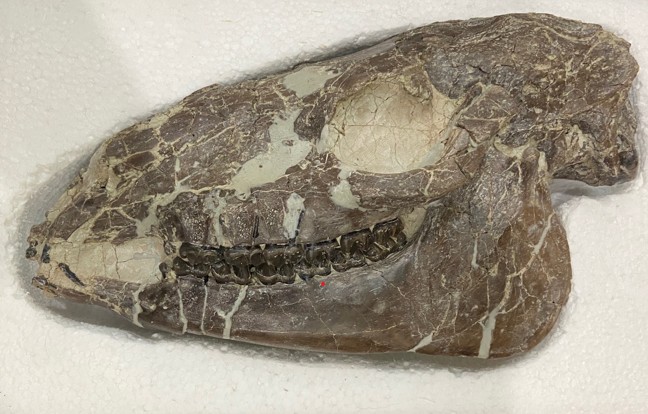
The finding was carefully removed from the ground, and after months of testing, it was determined to be the skull of a Mesohippus, an early form of today’s horse that lived 37 to 32 million years ago. It currently resides at the Florida Museum of Natural History in Gainesville.
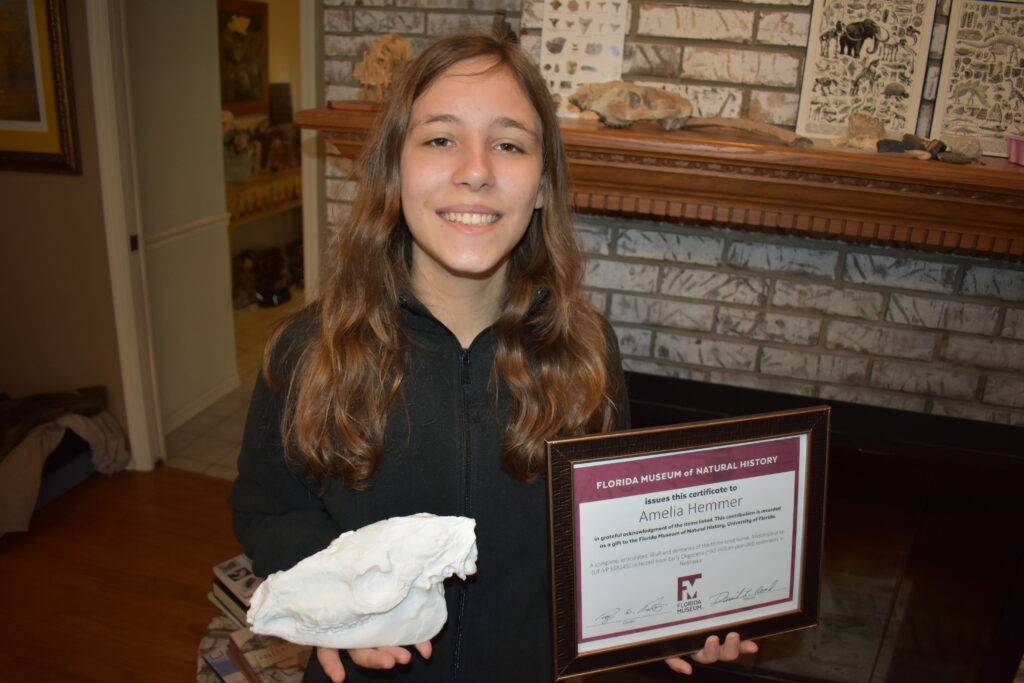
Paleontologists who studied Amelia’s discovery made during the summer of 2024 placed it at 32 million years old.
“Unbelievable,” said her mother, Hope Hemmer.
Amelia, 14, lives in east Manatee County with her parents and envisions a career searching for bones, teeth, and assorted fossils – the remains of anything that lived and died long before the arrival of humans.
“That would be amazing,” she said.
With the help of a Florida educational choice scholarship, the budding paleontologist has a head start on what appears to be her life’s calling.
Home-educated, Amelia receives a Personalized Education Program (PEP) scholarship available through the Florida Tax Credit Scholarship Program managed by Step Up For Students. PEP provides parents of students who are not enrolled full-time in a private or public school with flexibility in how they spend their scholarship funds, allowing them to tailor their children’s learning to meet their needs and interests.
In addition to the core subjects, Amelia’s curriculum includes subjects related to paleontology, geology, archaeology, and dinosaur science.
“We love it,” Hope said. “It gives us flexibility. She takes her regular courses, but she can also dive deeper into paleontology.”
PEP also covers the fees of the four paleontology clubs that Amelia joined – The Florida Paleontology Society, the Tampa Fossil Club, the Manasota Fossil Club, and the Imperial Bone Valley Gem, Mineral & Fossil Society. It has paid for some of the tools Amelia uses to dig for fossils, admission to fossil dig sites and museums, and the scores of related books that fill the Hemmers’ home.
“I’m thrilled she’s found something that she enjoys,” said her father, Tony.
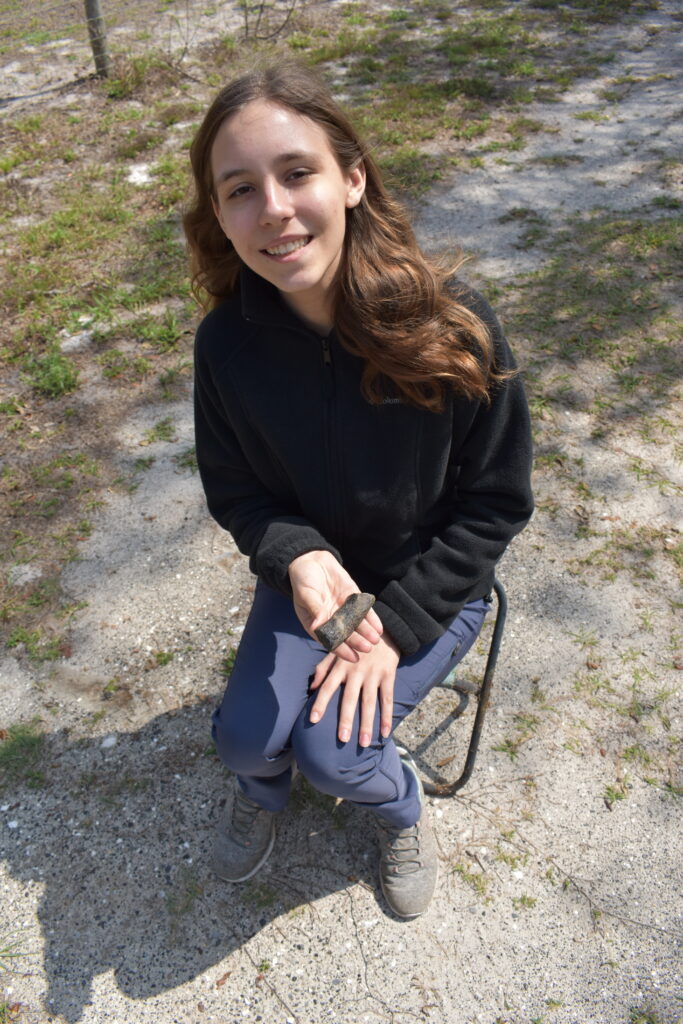
He was there at the beginning, back when Amelia was 5 or 6 and digging around the family property for diamonds or emeralds. She uncovered what she called “a really weird rock.” It was black and cylindrical, about two inches long. It wasn’t smooth, like a rock. It had small ridges.
“It’s not a rock,” Tony told his daughter. “It’s a bone.”
They took it to the Bishop Museum of Science and Nature in nearby Bradenton. A paleontologist there determined it was a rib bone of a dugong, a manatee-like mammal that is still in existence.
How it ended up on the Hemmer property is a mystery. It might have died there when the Florida peninsula was still underwater, or it might have been mixed with the fill dirt brought in by the previous owners to make a driveway.
Either way, it’s estimated to be 10 million years old.
Forget diamonds and emeralds, Amelia was hooked on bones and fossils.
She has been to fossil sites around Florida, Kentucky, South Carolina, and Nebraska.
She has boxes filled with shark teeth, tips of stingray tails, saber tooth, turtle shells, and bones. Resting on the fireplace mantle in the family’s living room are two oreodont skulls, which she collected while in Nebraska.
Amelia is interested in animals from the Oligocene period, which was 34 million to 23 million years ago.
“I just find it more interesting,” she said. “Personally, I just feel it's more exciting discovering a saber tooth, or all these horses, and learning about them than I do learning about dinosaurs.
“Now maybe that's because I'm only learning about dinosaurs, and if I actually discover one, then maybe I'd be interested. But for now, I feel more interested in that period.”
Amelia is scheduled to spend a month this summer in South Carolina at the Charleston Center for Paleontology. Fossil digs there have uncovered dolphin and whale bones.
“I’ll do some digging, some preparing, which hopefully I can learn more about, so when I'm digging and find stuff, possibly I can prepare it on my own,” she said.
Amelia and her parents visited the center earlier this year. When they were leaving, she turned to her folks and asked, “Can I stay?”
She had the same reaction on the last day of the Nebraska dig. Hope mentioned that they’d soon trade the musty hotel they were staying in for one with a nicer bed and a hotter shower in Rapid City. Amelia nearly cried at the thought of leaving.
Nebraska is where Amelia felt she became a paleontologist, when she knew she had found her true passion.
Amelia and Hope were with a group sponsored by the Bishop Museum. They flew to Rapid City, South Dakota, and did some sightseeing before heading a few hours south to the Badlands of Nebraska.
For four days the group dug along the dusty riverbed. Amelia found a saber tooth, a brain cast from some undetermined ancient creature, and the oreodont skulls. She was allowed to keep them because they are so common.
“It was more of just looking around,” she said of the four days. “There were multiple times where there were misses, where I would look in this crack and think, ‘Oh, look at all these ribs.’ And then it's like, no, that's actually where the water eroded the rocks. So, you just kind of had to look and then guess. So, it's mostly just trying to run around and be the first person to find something.”
That was the story of her Mesohippus.
Members of the group walked past it, but only Amelia noticed the shape of an eye socket. The paleontologists on the trip, including one from the Florida Museum of Natural History, staked out a perimeter and began to dig a circle around the skull, leaving plenty of room to collect whatever bones might be attached.
There were none, but the skull was prize enough.
It took a year for Amelia to learn what she discovered was a rare Mesohippus. She found out during an event last July at the Bishop Museum, when she opened a box with the skull inside. She then donated it to the Florida Museum of Natural History.
The museum might place it on display, or it might be used for additional testing.
Amelia has a 3-D printed model of her Mesohippus and the knowledge that at the age of 12, she discovered something that sat unseen and untouched for 32 million years, longer than the history of mankind.
“I’m really excited about the find,” she said, “and to know it’s in a museum, that’s pretty cool.”
Roger Mooney, manager, communications, can be reached at [email protected].
Do you need more information about scholarships managed by Step Up For Students?


